
Hi there,
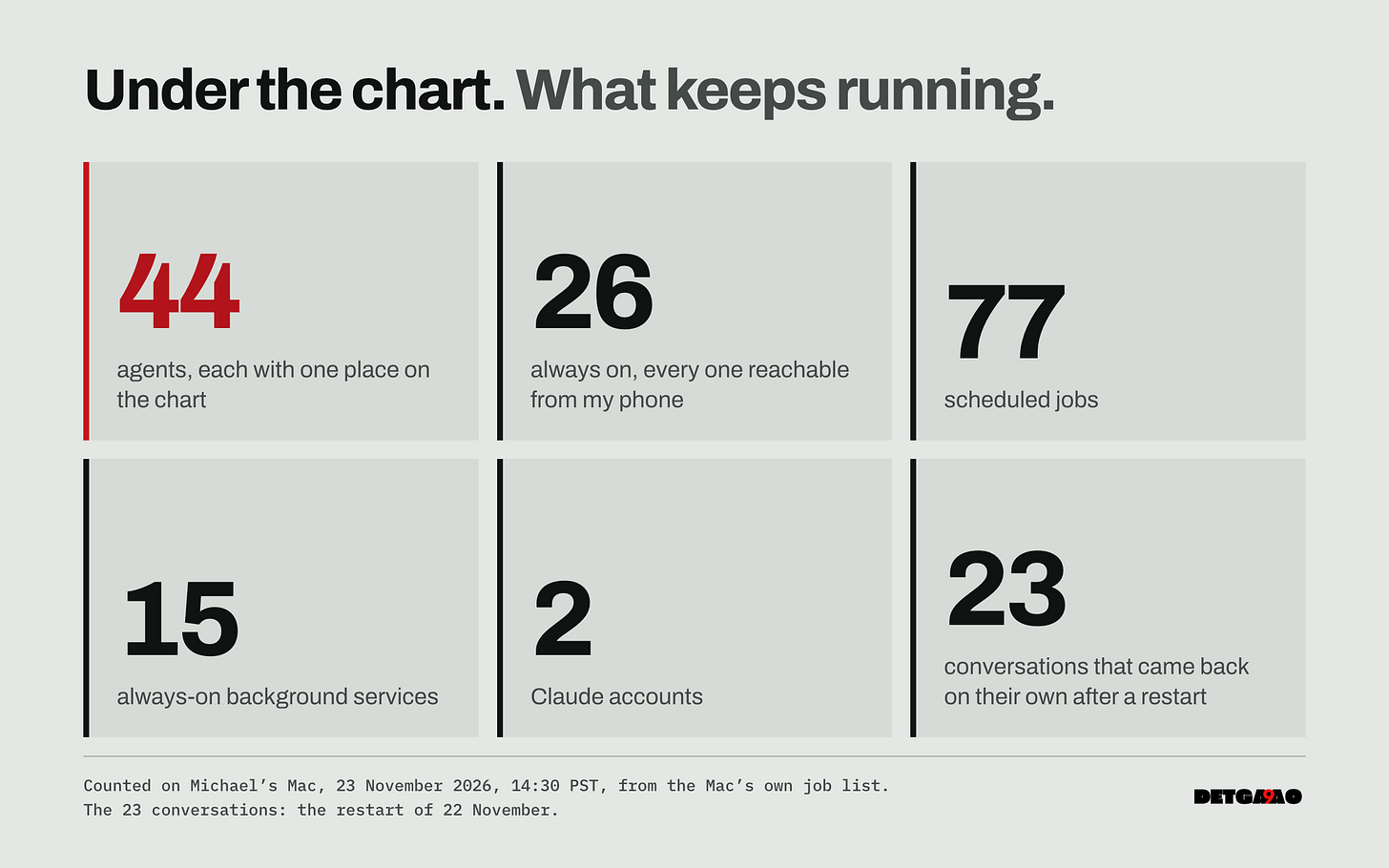
A few issues back I told you about the team I built out of AI agents instead of people. It kept growing: there are 44 on the chart now, 26 of them always on. On 22 November they got an org chart. With a COO, a CMO and a CTO.
Overkill? Maybe. :-) And no, I haven’t lost my mind. I know they’re not alive.
Look up advice on working with AI agents and much of it says the opposite: start small.
They have a point.
Where they’re right
OpenAI’s April 2025 guide to building agents says to “maximize a single agent’s capabilities first”, because more agents “can introduce additional complexity and overhead”. Cognition, the company behind the Devin coding agent, went further in June 2025: that year, it said, agents working together “only results in fragile systems”. Even Anthropic’s documentation for teams of Claude Code agents says to start with three to five.
One study backs the worry. Researchers at UC Berkeley went through 1,642 recorded runs of seven open-source multi-agent systems, on GPT-4o-era models, and found them failing at their task between 41% and 86.7% of the time. Many of those failures, they concluded, come from how the agents are organised and coordinated, not from the limits of any one agent.
Why I went big anyway
Much of that advice is about several agents splitting one job at the same moment. Mine mostly don’t. Each one has a job of its own: building one app, marketing one brand, planning my travel, helping me write this. That’s closer to a small company than to one big task cut into pieces. And nobody tells a small business to hire one person and stop there.
And like any small company, at some point I stopped being sure who owned what.
What the chart is
So since 22 November, every agent has one boss. The COO gets the products and the agents that build them, the CMO the brands, the CTO the tools and the Mac, and a lead runs the content team. A handful report straight to me.
There’s one rule: sites and products go to the COO, brands go to the CMO.
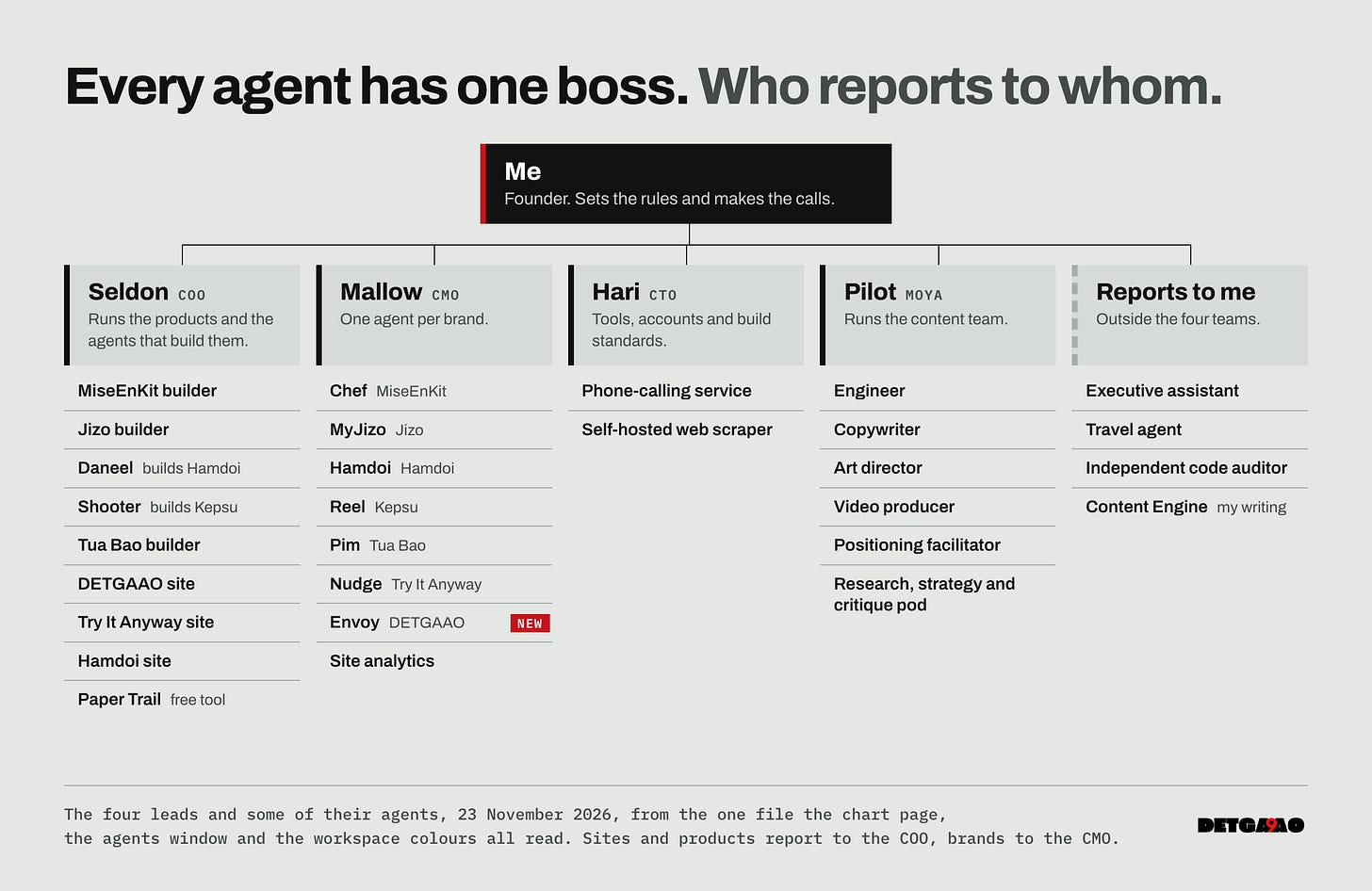
The whole chart is one file. The org chart page reads it, so does the window where I watch the agents work, and it even sets the colour of each agent’s workspace. Move an agent in the file, and nothing else has to be edited by hand.
What it cost me
The rule lasted a day. On 23 November DETGAAO got its own brand agent, and its social posts are moving to it. I kept the DETGAAO blog with the agent that helps me write. So one brand now has two agents writing for it. That could be a mistake. Ask me in a month.
And there’s a lot to keep running. When we counted on 23 November, 26 agents were always on, and 77 scheduled jobs and 15 background services ran around them. No wonder I lost track.
Day one
The first test was that same move. My writing agent got its instructions from the brand agents’ boss: keep posting each DETGAAO channel until the new agent says it has taken that one over. Which accounts, what’s scheduled, what works: the two agents sort that out between them.
My part was two calls: yes to the new agent, and keeping the blog. I didn’t do the work, and I didn’t hand it out either. I made sure that when something needs doing, it’s obvious whose it is to do.
So, one agent or many?
I didn’t start small. It cost me an org chart, a rule I broke in a day, and a lot of moving parts. I’d do it again.
You decide.
And if you’ve tried AI agents: did you start with one, or go big? Reply and tell me, and whether you’d do it the same way again.
Michael