
Hi there,
I’ve worked remotely from Da Nang and from Bangkok, and if you made me choose, I’d pick Da Nang.
Before I tell you why, here is the case against my own answer. I looked up the logistics properly, and most of it points the other way.
Where Bangkok wins
The visa. Thailand has a visa built for people like me. The Destination Thailand Visa lists “Workcation” first, and names digital nomads and remote workers. It’s valid for five years, lets you stay up to 180 days per entry, and can be extended once by another 180. You need at least 500,000 baht in the bank. The fee depends on where you apply: the Thai consulate in Ho Chi Minh City quotes USD 340. One change worth knowing: since 31 August 2026 you also need proof of permanent residence and a criminal record certificate.
Vietnam’s answer is the e-visa. 90 days, multiple entry, open to every nationality, USD 50. Simple, but you’re back at the border every three months. VnExpress reports that Vietnam’s new five-year visas from July 2026 are aimed at tech specialists, not remote workers in general.
Flights. In a 2025 FlightConnections ranking reported by Time Out, Suvarnabhumi had more airlines than any airport on earth: 113, flying to 151 destinations. Da Nang’s own airport site lists 42 airlines. If you hop around the region, Bangkok is the hub.
Fixed internet. In Ookla’s study of 13 digital nomad hubs in Southeast Asia (Q2 2026), Bangkok’s fixed broadband ran at a median 317 Mbps, behind only Singapore. Da Nang managed 272. Both are plenty for video calls. Bangkok is still faster.
Desks. I expected Da Nang to be cheaper. Not at Regus: its Da Nang centre lists a coworking desk from VND 4.79 million a month, while its cheapest Bangkok desk starts at THB 3,590. Independent spaces come out close to even. Coworking Danang is VND 3 million a month, The Hive Thonglor in Bangkok from THB 4,000. (Da Nang also has a brand new, huge one, HI4 Coffee & Workspace, which I liked a lot.)
Where Da Nang wins
Living costs. On Numbeo, which is crowd-sourced, so treat it as a rough guide, living in Bangkok costs 47.4% more than Da Nang once rent is included. Rent alone is 49.1% higher, restaurants 71.9%.
Mobile data. Da Nang had the fastest mobile internet of those 13 hubs, a median 215 Mbps against Bangkok’s 167. Fair warning, it was also the only hub that got slower, down 17.7% in a year.
Traffic. Bangkok had the 10th most congested city centre in TomTom’s 2025 Traffic Index: 115 hours a year lost in rush hour, and 23 minutes on average to drive 10 km. Da Nang isn’t in the index at all. From what I rode, it doesn’t need to be.
The two things no table has
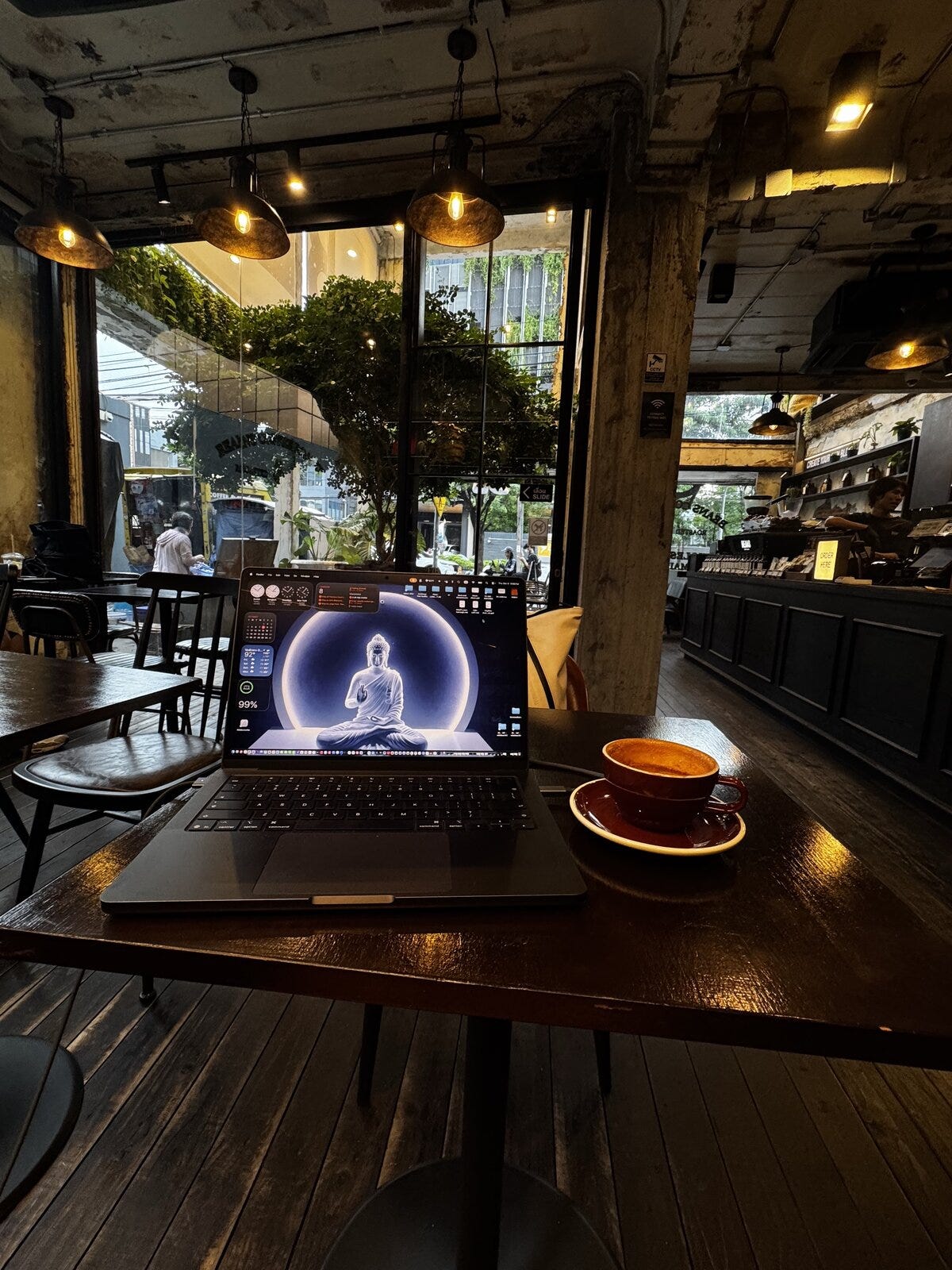
The coffee shops. Most days part of my work happens in one, so for me this row weighs more than the internet speed. Bangkok’s trend is hyper modern and not made for sitting long. In Da Nang I sit down and stay.

The ride. The Son Tra peninsula is 10 km from central Da Nang. Hai Van Pass is about 20 km north. Along the beach, up into the mountains, back to the laptop. Inner city Bangkok has nothing like it.
Check this before you ride in Vietnam
Vietnam only accepts international driving permits from countries in the 1968 Vienna Convention, and only together with your national licence. Look up which convention your permit was issued under before you rent a bike.
So
If you need a long visa, constant flights and the fastest home internet, the numbers say Bangkok. If what keeps you working is a good chair, a lower rent and a road along the sea, that’s where I landed.
Your list might weigh the other way. Which row would decide it for you?
Michael